Types of Metal Casting Processes: A Practical Guide
When sourcing cast metal components, the process used to make them affects cost, lead time, surface finish, dimensional accuracy, and minimum order quantity. This guide covers the main casting processes so you can compare them against your requirements.
Investment Casting (Lost Wax Casting)
Investment casting produces parts by building a wax pattern, coating it in ceramic, burning out the wax, and pouring molten metal into the cavity. It delivers the best combination of geometric complexity, surface finish, and dimensional accuracy of any casting method. Tolerances: ±0.1–0.25mm as-cast, tightened to ±0.01–0.05mm with secondary CNC machining. Surface finish: Ra 1.6–6.3μm as-cast — often usable without further finishing. Best for: complex geometry, thin walls, tight tolerances, difficult alloys (stainless steel, nickel alloys, duplex steel, cobalt chrome). Typical industries: aerospace, oil and gas, food machinery, marine, medical. Typical tolerances: ±0.1–0.25mm as-cast, tightened to ±0.01–0.05mm after secondary CNC machining. Common materials: stainless steel (304, 316L, 2205 duplex), carbon steel, nickel-based alloys, aluminium, brass.

Sand Casting
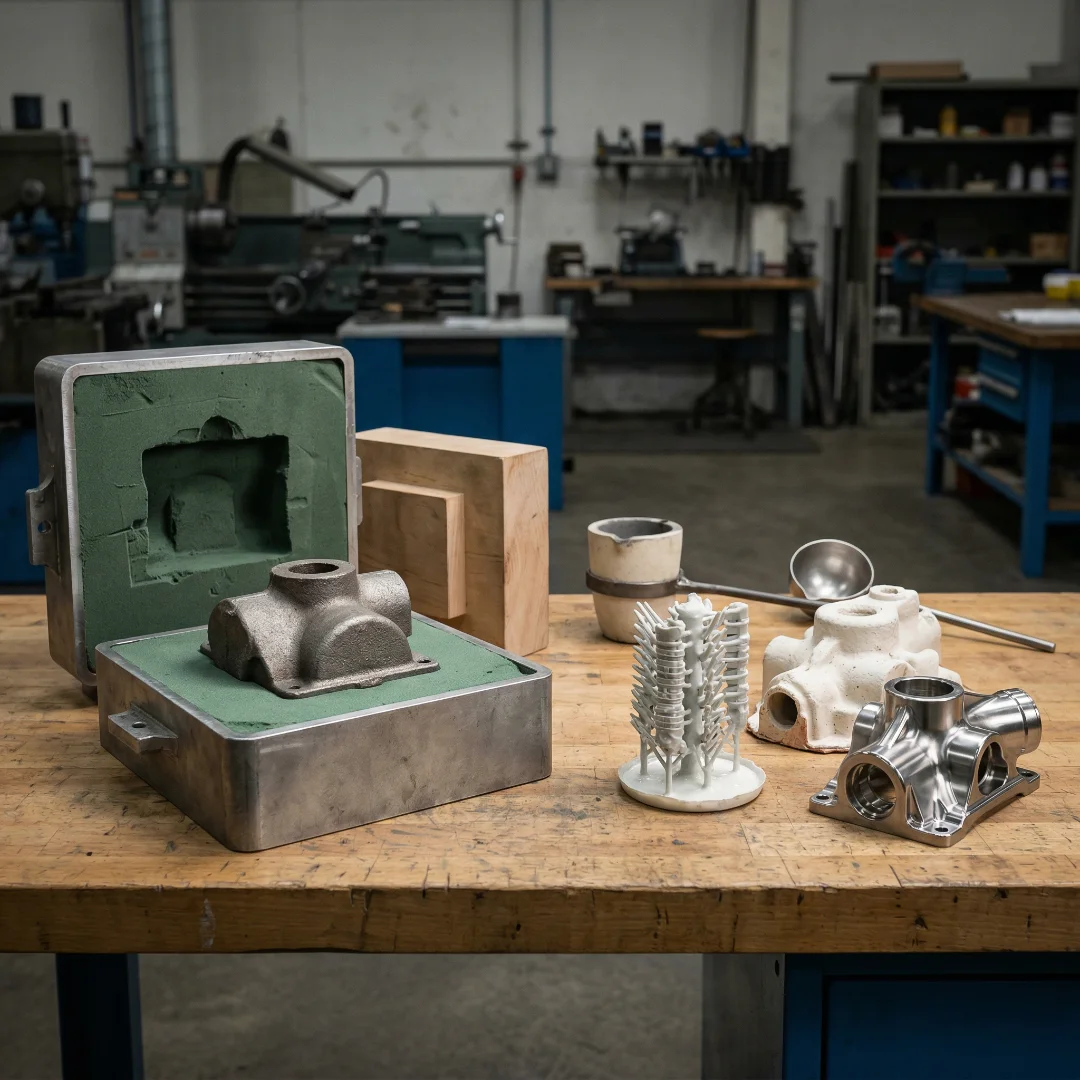
Sand casting uses a compacted sand mould to form the cavity. It is the oldest and most widely available casting process — almost any metal can be sand cast, and there is no practical upper limit on part size. Tolerances: ±0.5–1.5mm depending on part size and complexity. Surface finish: Ra 12.5–25μm — rough, usually requires significant machining. Best for: large parts, low volumes, simple geometry, early prototypes where accuracy is not critical. Limitations: poor surface finish, low dimensional accuracy, not suited to thin walls. Typical tolerances: ±0.5–2mm for hot forging, tighter for cold forging with secondary machining. Common materials: carbon steel, alloy steel, aluminium, titanium.
Permanent Mould Casting (Gravity Die Casting)
Permanent mould casting pours metal by gravity into a reusable steel mould without applied pressure. It sits between sand casting and die casting in terms of accuracy and cost. Tolerances: ±0.2–0.5mm. Surface finish: better than sand casting, inferior to die casting. Best for: medium volumes of aluminium or copper alloy parts where die casting tooling cost is not justified.
Die Casting
Die casting forces molten metal under high pressure into a hardened steel die. It is the fastest casting process for high volumes and produces excellent surface finish and repeatability. Tolerances: ±0.05–0.1mm. Surface finish: Ra 0.8–3.2μm — often requires no further finishing. Best for: high-volume production of small to medium aluminium, zinc, or magnesium parts. Limitations: high tooling cost (£10,000–£50,000+), limited to non-ferrous metals, wall thickness constraints, porosity risk in thick sections.
Shell Moulding
Shell moulding uses a thin resin-bonded sand shell as the mould. It produces better accuracy and surface finish than conventional sand casting at moderate cost. Tolerances: ±0.25–0.5mm. Surface finish: Ra 3.2–6.3μm. Best for: medium-complexity parts in iron or steel where investment casting is too expensive but sand casting is too rough.
Process Comparison
| Process | Tolerances | Surface Finish | Tooling Cost | Best Volume | Alloys |
|---|---|---|---|---|---|
| Investment casting | ±0.1–0.25mm | Ra 1.6–6.3μm | Low–medium | 1–5,000 | Most alloys |
| Sand casting | ±0.5–1.5mm | Ra 12.5–25μm | Very low | 1–500 | Most alloys |
| Die casting | ±0.05–0.1mm | Ra 0.8–3.2μm | Very high | 10,000+ | Al, Zn, Mg only |
| Permanent mould | ±0.2–0.5mm | Ra 3.2–12.5μm | Medium | 500–10,000 | Al, Cu alloys |
| Shell moulding | ±0.25–0.5mm | Ra 3.2–6.3μm | Low–medium | 500–5,000 | Iron, steel |
Which Process Is Right for Your Part?
Choose investment casting if > your part has complex geometry, requires good as-cast surface finish, is made from stainless steel or a difficult alloy, or is needed at low to medium volumes. Choose sand casting if > your part is large, simple, and needed in small quantities where surface finish and tight tolerances are not critical. Choose die casting if > you are producing tens of thousands of small aluminium or zinc parts and can justify the tooling investment. Choose permanent mould if > you need better quality than sand casting allows but cannot justify die casting tooling costs. If you are unsure which process suits your component, send us a drawing and we will advise — with no obligation.