CNC Machining After Casting: When and Why Secondary Operations Add Real Value
Investment casting produces near-net-shape parts with excellent surface finish and good dimensional accuracy, but near-net-shape is not the same as finished. For many components, secondary CNC machining is a planned and deliberate step in the manufacturing process, not a remedy for poor casting quality. Understanding when CNC machining adds value, and why, helps engineers and buyers make better decisions when specifying how components should be produced.
What Investment Casting Can and Cannot Achieve
Investment casting typically delivers dimensional tolerances of ±0.1 to 0.25mm as-cast, with surface roughness of Ra 1.6 to 6.3μm. For a large proportion of features on most components, this is entirely adequate and no further machining is required. However, certain feature types and tolerance requirements are beyond what investment casting can reliably achieve alone: Tight dimensional tolerances on functional surfaces (±0.01 to 0.05mm) such as bearing seats, sealing faces, and mating flanges. Precision holes, threads, and bores where alignment and surface quality are critical. Small diameter holes (under 6mm) and fine threads are more reliably produced by drilling and tapping after casting than by casting directly. Surface finishes below Ra 0.8μm on specific functional surfaces such as hydraulic sealing faces or valve seats. For these features, CNC machining after casting is the standard and correct approach.

When CNC Machining Is Essential
Tight Tolerances on Functional Surfaces
A valve body might be perfectly acceptable as-cast on all its external surfaces, but the bore that accepts the valve seat must be concentric and to within ±0.02mm to function correctly. Achieving this in the casting alone is unreliable. Boring or grinding that surface after casting guarantees the required tolerance regardless of the normal casting variation.
Precision Threaded Features
Cast threads are feasible for coarse pitches and relatively large diameters (M8 and above), but for smaller or finer threads, and for threads where thread quality is safety-critical, machined threads are significantly more reliable. Drilling and tapping after casting adds minimal cost and eliminates the risk of thread quality problems.
Sealing Faces and Mating Surfaces
Pump housings, valve bodies, and hydraulic manifolds require sealing faces that are flat, smooth, and within close tolerance on perpendicularity and position. These requirements are consistently met by face milling after casting. Attempting to achieve them through casting alone increases scrap risk.
Removal of Surface Porosity on Critical Surfaces
Investment casting produces very low levels of surface porosity, but on safety-critical or pressure-containing surfaces, even minor surface porosity is unacceptable. Machining removes the cast skin on these surfaces, exposing the sound metal beneath and ensuring leak-free performance.
Complex Internal Geometries
Some internal features, such as deep bores, precisely positioned holes, and intersecting passages, are better produced by machining than by casting. The casting provides the overall near-net shape, and machining creates the specific internal geometry required. This approach is faster and more reliable than attempting to cast every internal feature using complex ceramic core arrangements.
What CNC Operations Are Typically Applied After Casting
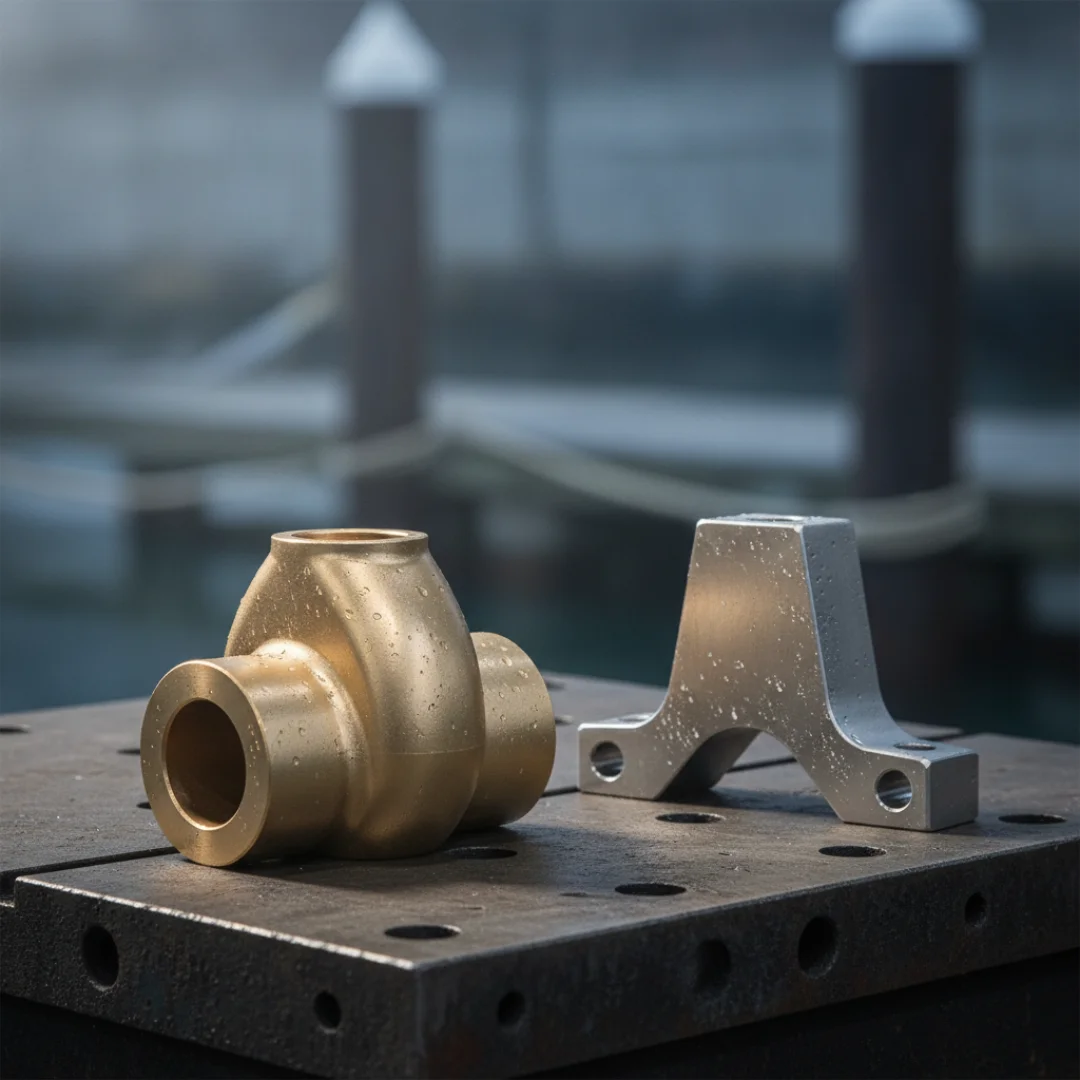
The most common secondary operations on investment castings are: Turning on a lathe for external diameter features, bearing journals, and sealing surfaces. Milling for flat surfaces, pockets, and boss faces. Drilling for holes that were not cast, or for enlarging and refining cast holes to precise diameter. Tapping for threaded features. Boring for precise internal diameters such as valve bores and bearing seats. Grinding on very tight tolerance or very fine surface finish requirements. In most cases, only a subset of the part’s features require machining. The as-cast surface is retained everywhere it meets the specification, which keeps machining time and cost to a minimum.
Casting Plus Machining vs Machining from Solid
The combination of investment casting and secondary CNC machining is typically more cost-effective than machining the same component from solid billet. The comparison is most significant for complex stainless steel and nickel alloy components.
| Factor | Machining from Solid Billet | Investment Casting + CNC Machining |
|---|---|---|
| Buy-to-fly ratio | 4:1 to 6:1 (complex parts) | 1.2:1 to 1.5:1 |
| Material waste | High — most raw material becomes swarf | Low — only functional surfaces machined |
| Machining time | High — full geometry from blank | Low — targeted operations only |
| Achievable complexity | Limited by tool access | High — complex geometry from casting |
| Final tolerance on functional surfaces | ±0.01 to 0.05mm | ±0.01 to 0.05mm |
| Surface finish on machined surfaces | Ra 0.4 to 1.6μm | Ra 0.4 to 1.6μm |
| Total cost (complex stainless parts) | Higher | Typically 40 to 60% lower |
| Lead time | Medium | Slightly longer (casting lead time + machining) |
The buy-to-fly ratio (the ratio of raw material input weight to finished part weight) illustrates the difference clearly. For a complex stainless steel valve body machined from solid bar, a buy-to-fly ratio of 4:1 to 6:1 is common. The same part produced by investment casting and machined on functional surfaces only has a buy-to-fly ratio of 1.2:1 to 1.5:1. The material saving is substantial, and since stainless steel and nickel alloys are expensive, this translates directly into part cost. Machining time is also reduced significantly. A near-net-shape casting requires only targeted machining on functional surfaces rather than material removal across the entire part.
Integrated Casting and Machining
For buyers who source investment castings separately and then send them to a machining shop, the handoff between operations introduces potential for dimensional discrepancies if datum features are interpreted differently, as well as logistics complexity and additional lead time. Suppliers who offer integrated casting and machining under one roof eliminate these issues. Castings move directly from the foundry to the machining centre with a consistent datum setup, full traceability, and no risk of specification misinterpretation between suppliers. The result is shorter total lead time and better control of final dimensions.