Casting vs Forging: Which Manufacturing Process Is Right for Your Part?
When specifying metal components, one of the most consequential decisions is whether to cast or forge. Both processes produce strong, accurate metal parts, but they suit very different applications, volumes, and budgets. The wrong choice at the design stage is expensive to undo once tooling is committed. This guide explains the practical differences so you can make the right call before work starts.

What Is Investment Casting?
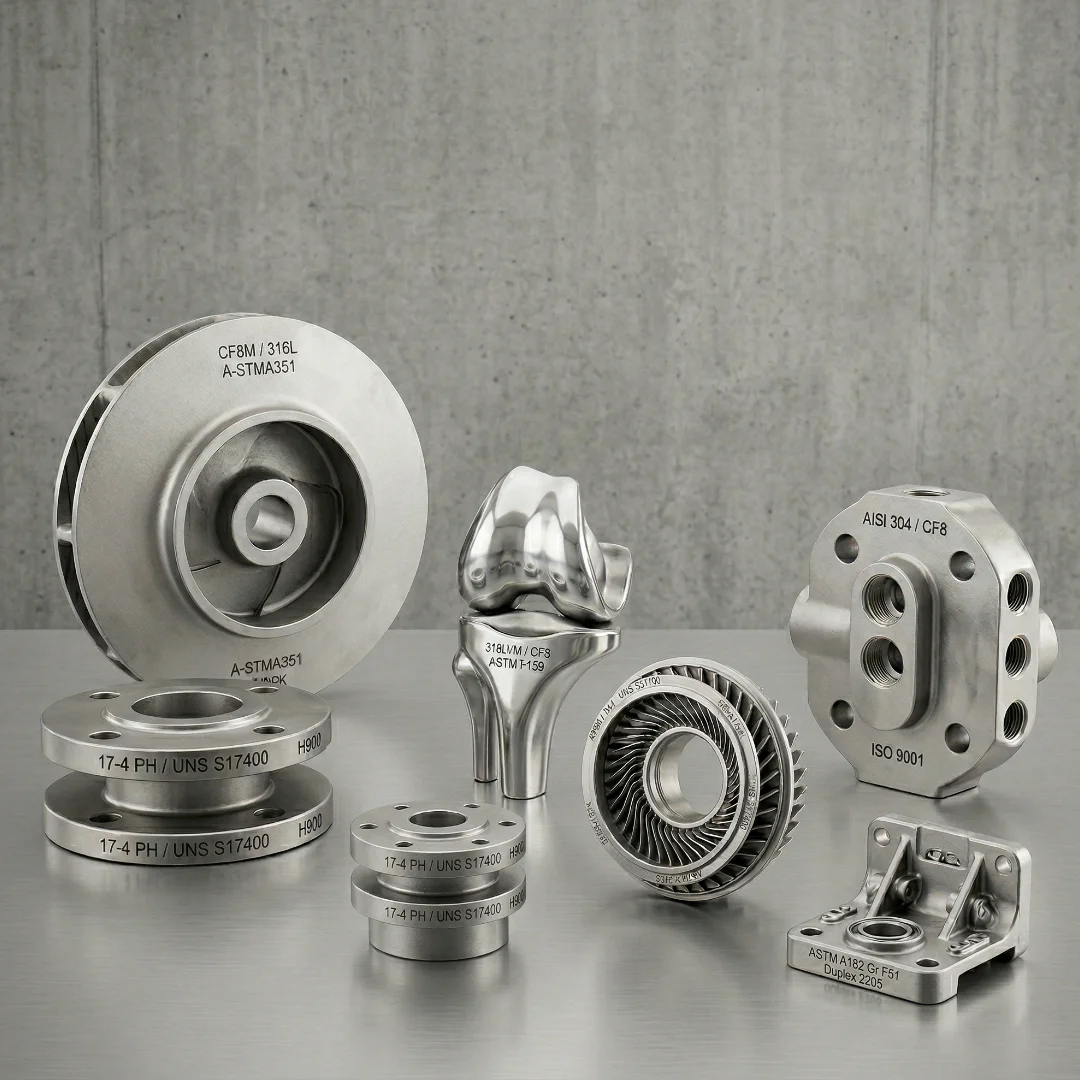
Investment casting, also called lost wax casting, produces parts by creating a wax pattern of the finished component, coating it in layers of ceramic slurry to form a shell, burning out the wax, and pouring molten metal into the cavity left behind. The ceramic shell is then broken away to reveal the casting. The result is a near-net-shape part, meaning it closely matches the final geometry and requires minimal material removal to reach specification. Investment casting handles complex three-dimensional geometry, internal passages, thin walls, and undercuts that most other processes struggle with. Surface finish as-cast is typically Ra 1.6 to 6.3 micrometres, which is often good enough for non-critical surfaces without any further finishing. Typical as-cast tolerances are plus or minus 0.1 to 0.25mm, tightening to plus or minus 0.01 to 0.05mm after secondary CNC machining on critical features. Common materials include stainless steel grades 304, 316L, and 2205 duplex, carbon steel, nickel-based alloys, aluminium, and brass.
What Is Forging?
Forging shapes metal by applying compressive force to a heated billet between dies. The metal is not melted. It is deformed in the solid or semi-solid state. This is a critical distinction. Because the grain structure of the metal is never disrupted by melting and re-solidification, forging produces parts with a continuous, aligned grain flow that follows the contours of the part geometry. This grain alignment is what gives forged parts their characteristic advantage in tensile strength, fatigue resistance, and impact toughness compared to cast equivalents in the same material. Hot forging heats the billet above its recrystallisation temperature before pressing, allowing large deformations without cracking. Cold forging works at or near room temperature and produces tighter dimensional accuracy but is limited to simpler shapes and more ductile materials. Typical tolerances for hot forging are plus or minus 0.5 to 2mm, improving significantly with secondary machining. Common materials are carbon steel, alloy steel, aluminium, and titanium.
How the Processes Compare
| Factor | Investment Casting | Forging |
|---|---|---|
| Shape complexity | Excellent. Internal cavities, thin walls, undercuts all achievable | Limited. Shape must allow die separation, no internal cavities |
| Surface finish as-produced | Very good (Ra 1.6-6.3um) | Rough. Requires significant machining |
| Dimensional accuracy | Good to excellent | Moderate. More machining required |
| Material strength | Good | Superior. Continuous grain structure |
| Fatigue resistance | Good | Excellent |
| Impact toughness | Good | Excellent |
| Tooling cost | Low to medium | Medium to high |
| Unit cost at low volume | Lower | Higher |
| Unit cost at very high volume | Competitive | Lower per piece |
| Typical lead time | 4 to 8 weeks | 6 to 12 weeks |
| Minimum viable quantity | Low. Prototypes feasible | Higher. Tooling cost requires volume to justify |
| Alloy range | Very wide. Most alloys including nickel superalloys and duplex steel | Narrower. Mainly steel, aluminium, titanium |
The Strength Question
Forged parts are stronger than cast parts in the same alloy. This is a reliable generalisation and it is worth understanding why, because it affects how much it matters for your application. When metal solidifies from a melt, the grain structure forms randomly as crystals nucleate and grow. The result is an isotropic structure with similar properties in all directions but no preferential alignment. Depending on how well the casting is controlled, there may also be micro-shrinkage, porosity, or segregation that reduce mechanical properties below the theoretical maximum for the alloy. Forging never melts the metal. The grains are deformed and elongated in the direction of material flow, which aligns them with the primary stress paths in the finished part. There is no porosity, no shrinkage, and no segregation. The result is a part with higher tensile strength, better fatigue life under cyclic loading, and superior resistance to crack propagation. For most industrial components such as valve bodies, pump housings, brackets, fittings, and food machinery parts, cast properties are more than adequate. The strength difference becomes critical in high-cycle fatigue applications such as aircraft structural components, crankshafts, connecting rods, and suspension parts, where the grain structure of a forging provides a meaningful safety margin that a casting cannot match. If your component will see high cyclic loading, shock loads, or must meet aerospace or safety-critical structural standards, forging is the right answer regardless of complexity or cost. For most other industrial applications, investment casting delivers sufficient mechanical properties.
The Complexity Question
This is where investment casting has a clear and decisive advantage. Forging requires that the die can be separated from the part after forming. This means every feature must have draft angles and there can be no undercuts, internal passages, or geometry that would lock the part in the die. Investment casting has none of these restrictions. Because the ceramic shell is broken away after casting rather than separated as a die, the process can produce almost any geometry that can be described in a CAD model, including curved internal channels, hollow sections, thin walls, complex external profiles, and multiple features that would otherwise require assembly of separate components. The practical implication is that a part which requires five separate forged and machined components bolted together can often be consolidated into a single investment casting. This reduces assembly cost, eliminates potential failure points at joints and fasteners, and simplifies quality inspection.
The Cost Question
Tooling cost comparison is more nuanced than it first appears. Investment casting tooling is typically lower cost than forging dies because the wax injection tool operates at much lower pressures than a forging die. However, forging dies once made have very long service lives and can produce hundreds of thousands of parts, which amortises the tooling cost to a negligible per-part figure at very high volumes. At low to medium volumes, up to a few thousand parts, investment casting is almost always more cost-effective per part when complexity is factored in. The lower tooling cost and reduced machining requirement for complex geometries significantly reduce total production cost compared to forging the same part and then machining it extensively to achieve the required geometry. At very high volumes of a simple, solid design in a forgeable alloy, forging’s lower per-piece production cost can outweigh the higher tooling investment. But this scenario applies to a narrow range of parts: high-volume, simple geometry, standard alloy.
When Casting and Machining Is Better Than Either Alone
For many components, the best and most cost-effective approach is not a choice between casting and forging but a combination of investment casting and secondary CNC machining. The casting provides the complex near-net shape, often including features that would be impossible to forge, and CNC machining is applied selectively to the surfaces that need tight tolerances or specific surface quality. This approach avoids the material waste and high machining time that comes from starting with a solid forged billet and removing large volumes of metal to achieve the final shape. For complex parts, starting from a near-net-shape casting can reduce total machining time substantially compared to machining from billet.
How to Decide
Start with the mechanical requirements. If ultimate fatigue strength, impact toughness, or aerospace structural certification is required, forging is the correct process. If the application is industrial, commercial, or consumer-grade and does not involve high cyclic loading, investment casting properties are adequate. Then consider geometry. If your part has internal passages, thin walls, undercuts, or complex external geometry, investment casting is likely the only practical option. If the part is solid and simple, both processes are viable. Then consider volume and cost. For prototypes and low volumes, investment casting’s lower tooling cost and ability to produce near-net-shape parts is a strong advantage. For very high volumes of a simple solid part in steel or aluminium, forging’s economics improve. Finally consider the alloy. Nickel superalloys, duplex stainless steel, cobalt chrome, and other high-performance alloys are routinely investment cast. Forging these materials is possible but significantly more challenging and expensive, and for some alloys is not practical at all. If you are unsure which process suits your component, send us a drawing and we will give you an honest assessment.