Stainless Steel Investment Casting: Grades, Properties and Applications
Stainless steel is one of the most commonly specified materials for investment casting. It combines corrosion resistance, mechanical strength, and good castability across a range of grades suited to very different operating environments. This guide covers the main stainless steel grades used in investment casting, their properties, and how to select the right one for your application.
Why Stainless Steel Is Well Suited to Investment Casting
Stainless steel alloys have relatively high melting points and can be difficult to machine from solid billet, particularly duplex and high-alloy grades. Investment casting produces near-net-shape parts that minimise machining while achieving good surface finish and dimensional accuracy — which makes the combination of stainless steel and investment casting particularly cost-effective for complex components. Investment casting also allows wall thicknesses and internal geometries that would be impractical or impossible to machine, giving designers more freedom than wrought or forged alternatives.
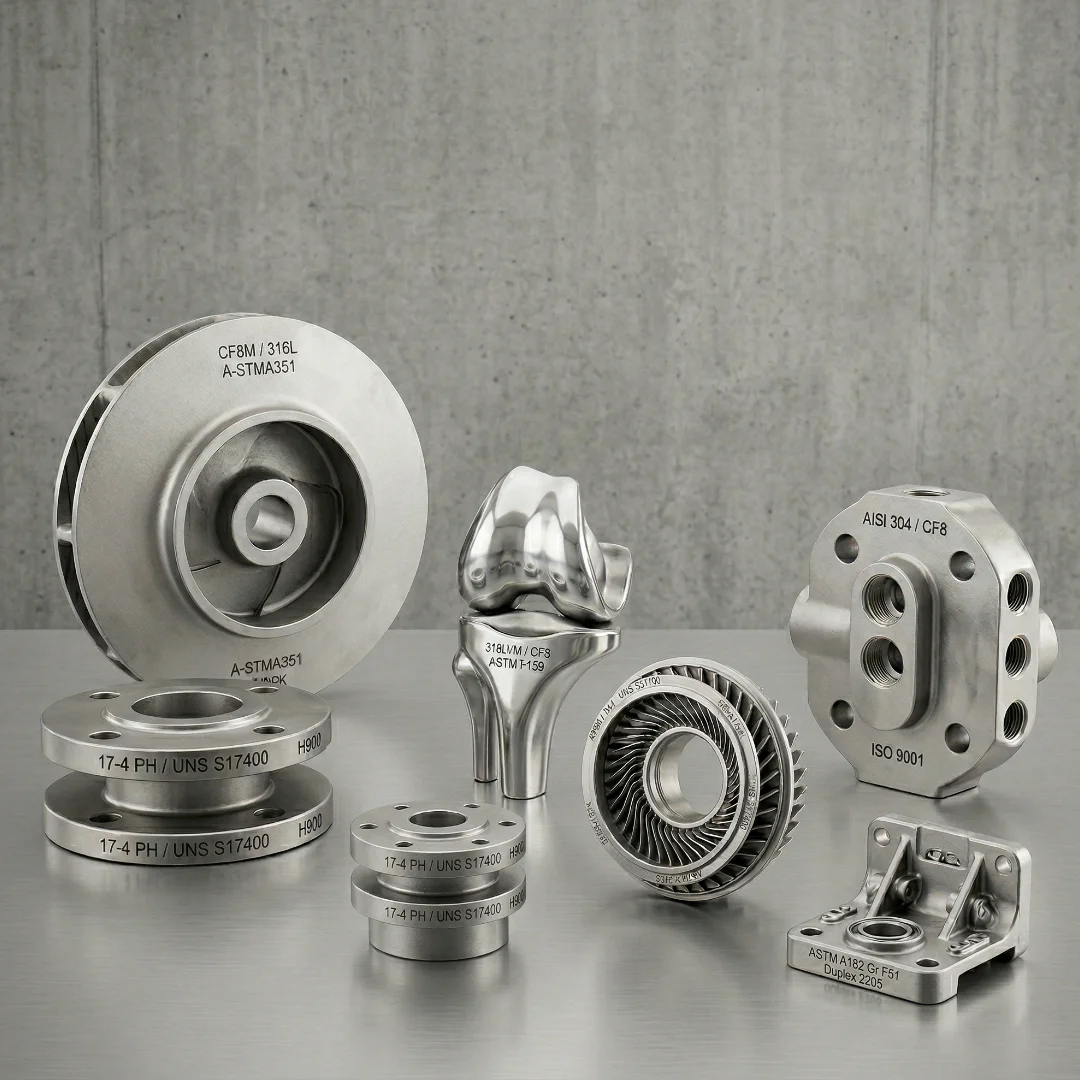
Common Stainless Steel Grades for Investment Casting
304 Stainless Steel
304 is the most widely used austenitic stainless steel. It offers good general corrosion resistance, is easy to cast, and is cost-effective for most non-aggressive environments. Composition: 18% chromium, 8% nickel. Corrosion resistance: Good in atmospheric and mild chemical environments. Not suitable for chloride-rich environments or marine applications. Typical applications: food processing equipment, architectural hardware, general industrial components.
410 Stainless Steel
410 is a martensitic grade with moderate corrosion resistance but high hardness and wear resistance after heat treatment. It is used where wear and mechanical performance take priority over corrosion resistance. Typical applications: wear-resistant components, valves in mildly corrosive environments, cutlery and blades.
17-4 PH Stainless Steel
17-4 PH is a precipitation-hardening grade that achieves significantly higher strength than austenitic grades while retaining good corrosion resistance. It can be heat treated after casting to reach required mechanical properties. Composition: 15–17% chromium, 3–5% nickel, 3–5% copper. Tensile strength: Up to 1,310 MPa in H900 condition. Typical applications: aerospace structural components, pump shafts, valve stems, marine fasteners.
316L Stainless Steel
316L adds molybdenum to the 304 composition, significantly improving resistance to chlorides and pitting corrosion. The low carbon content reduces the risk of sensitisation during welding or high-temperature exposure. Composition: 16–18% chromium, 10–14% nickel, 2–3% molybdenum. Corrosion resistance: Excellent in chloride environments, marine conditions, and many chemical processing applications. Typical applications: marine hardware, pharmaceutical and food machinery, oil and gas components, medical instruments.
2205 Duplex Stainless Steel
2205 duplex has a mixed austenitic and ferritic microstructure that gives it approximately twice the yield strength of 304 or 316L, combined with excellent resistance to stress corrosion cracking. It is the preferred choice where high strength and corrosion resistance are both required. Composition: 22% chromium, 5% nickel, 3% molybdenum, 0.15% nitrogen. Corrosion resistance: Excellent in chloride and marine environments. Superior to 316L in stress corrosion cracking resistance. Typical applications: oil and gas valves and manifolds, desalination equipment, marine structural components, chemical processing.
Tolerances and Surface Finish
Stainless steel investment castings typically achieve: As-cast dimensional tolerance: ±0.1–0.25mm. As-cast surface finish: Ra 1.6–6.3μm. After CNC machining on functional surfaces: ±0.01–0.05mm tolerance and Ra 0.4–1.6μm surface finish. Most functional surfaces, sealing faces, bearing seats, threaded interfaces, are machined after casting. Non-functional surfaces are often acceptable as-cast.
Design Considerations
Wall thickness — minimum recommended wall thickness for stainless steel investment casting is 1.5–2mm for most grades. Duplex grades require slightly more care due to higher solidification shrinkage. Section transitions — abrupt changes in wall thickness create hot spots that increase shrinkage risk. Gradual transitions and generous radii improve casting soundness. Post-cast machining — design critical surfaces to allow a 0.5–1mm machining allowance where tight tolerances are needed. Heat treatment — 17-4 PH and martensitic grades require post-cast heat treatment to achieve specified mechanical properties. Allow for this in your lead time.
Grade Comparison
| Grade | Type | Yield Strength | Corrosion Resistance | Best For |
|---|---|---|---|---|
| 304 | Austenitic | 205 MPa | Good | General industrial |
| 316L | Austenitic | 170 MPa | Excellent | Marine, chemical, food |
| 2205 Duplex | Duplex | 450 MPa | Excellent | High strength + corrosion |
| 17-4 PH | Precipitation hardening | Up to 1,170 MPa | Good | High strength applications |
| 410 | Martensitic | 275 MPa | Moderate | Wear resistance |