Investment Casting for Construction Hardware: Handrail Fittings, Connectors and Cover Plates
Modern railing and balustrade systems ask a lot of their hardware. Connectors, spigots and brackets need to fit precisely, look clean on a finished building, and hold up outdoors for years, often in coastal or urban environments where corrosion is a real risk. Getting all three right at once usually means choosing the right process for each part, not just the right material. This article covers which parts suit investment casting, which suit stamping, and when it is worth specifying duplex 2205 over standard stainless. This article covers the alloys that perform well in marine service, the parts we commonly cast for marine use, and why the casting process itself suits this kind of hardware.
Why Construction Hardware Needs More Than Off the Shelf Fittings
A glass balustrade connector or a handrail spigot rarely has a simple shape. It needs to grip a glass panel or tube cleanly, present a finished face to the public, and often carries real structural load. Standard extruded or machined fittings can only go so far before cost or geometry becomes a problem. Outdoor exposure adds another layer. Coastal air, pool surrounds and salted winter roads all introduce chlorides that attack standard stainless steel over time. Hardware specified for these environments needs to hold its finish and its structural integrity for the life of the building, not just pass inspection on installation day.
Which Parts Should Be Cast, and Which Should Be Stamped
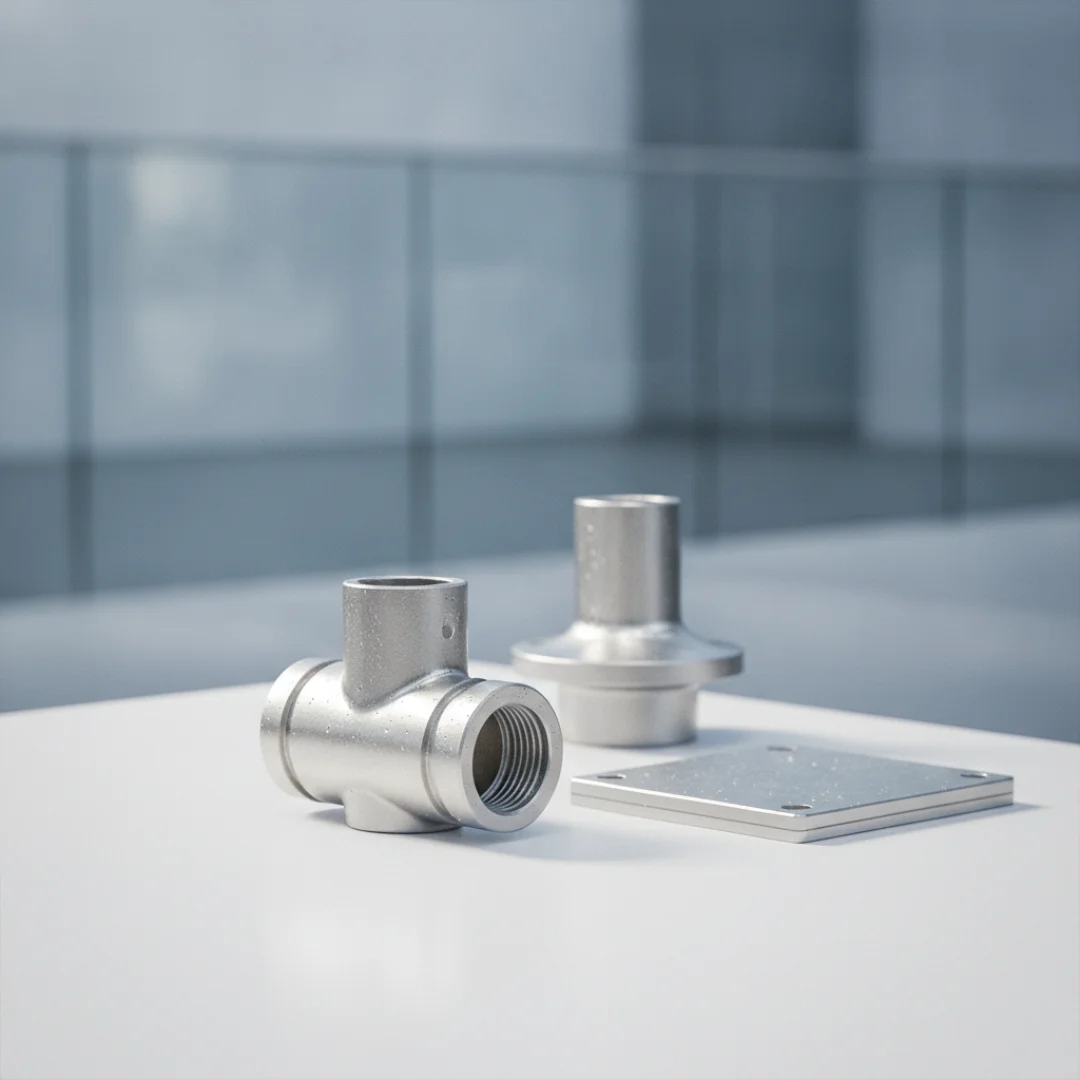
This is the decision that actually matters for cost and lead time, more than the alloy choice itself. Complex three dimensional parts, such as handrail connectors, balustrade spigot bodies and bracket and latch hardware, suit investment casting well. These shapes combine curves, internal features and a finished aesthetic surface that would be expensive or impossible to machine from bar stock, and casting produces them as one clean piece. [link: handrail-connector] [link: glass-balustrades] [link: bracket-latch] Flat or simply formed parts, such as cover plates and base plates, are usually better suited to stamping. Sheet forming is faster and cheaper for this geometry at volume. The complication is that duplex 2205 is harder to stamp than standard stainless, since it has higher yield strength and more springback, so the tooling and press setup need to account for that. [link: metal-stamping-explained]
Choosing Between 316L and Duplex 2205 for Architectural Hardware
Both grades show up regularly in construction hardware, and the right choice depends on exposure rather than a blanket upgrade. For the full material chemistry and properties, see our guide to duplex 2205. [link: why-choose-2205-steel] The short version for architectural hardware specifically is below.
| Exposure | Recommended Grade | Why |
|---|---|---|
| Indoor or dry urban settings | 316L Stainless | Good corrosion resistance at lower cost, easier to form and finish |
| Coastal, poolside or high chloride exposure | Duplex 2205 | Higher resistance to pitting and stress corrosion cracking where 316L can eventually fail |
| Large facade runs with repeated cover plates | 2205 where budget allows, 316L otherwise | 2205 stamping needs more tooling investment, worth it on long term or high value projects |
Hardware We Already Produce for This Industry
Our handrail connector and glass balustrade fittings are cast for exactly this kind of application, with the clean surface finish and precise fit that outdoor railing systems need. Our bracket and latch hardware follows the same approach for structural connections. If you have a similar fitting in mind, sending us a drawing is the fastest way to find out whether casting or stamping is the better fit for your part.
Why Investment Casting Suits Architectural Connector Geometry
Railing systems often run the length of a building, which means every connector and spigot needs to look identical and fit the same way. Investment casting holds that consistency across a full production run, without the part to part variation that can creep in with machined or welded fabrications. The process also handles the internal features, curves and mounting bosses that a modern connector design usually needs, as one piece rather than several welded together. Fewer joints means fewer places for corrosion to start once the hardware is installed outdoors.