Powder Coating for Metal Parts: Indoor vs Outdoor Durability Guide
Powder coating is one of the most widely used surface finishing methods for metal components. It produces a hard, uniform finish that resists chipping, corrosion, and wear, and it is available in a wide range of colours, textures, and gloss levels. Understanding how the process works and what drives durability helps you specify the right coating for your application from the outset.
How Powder Coating Works
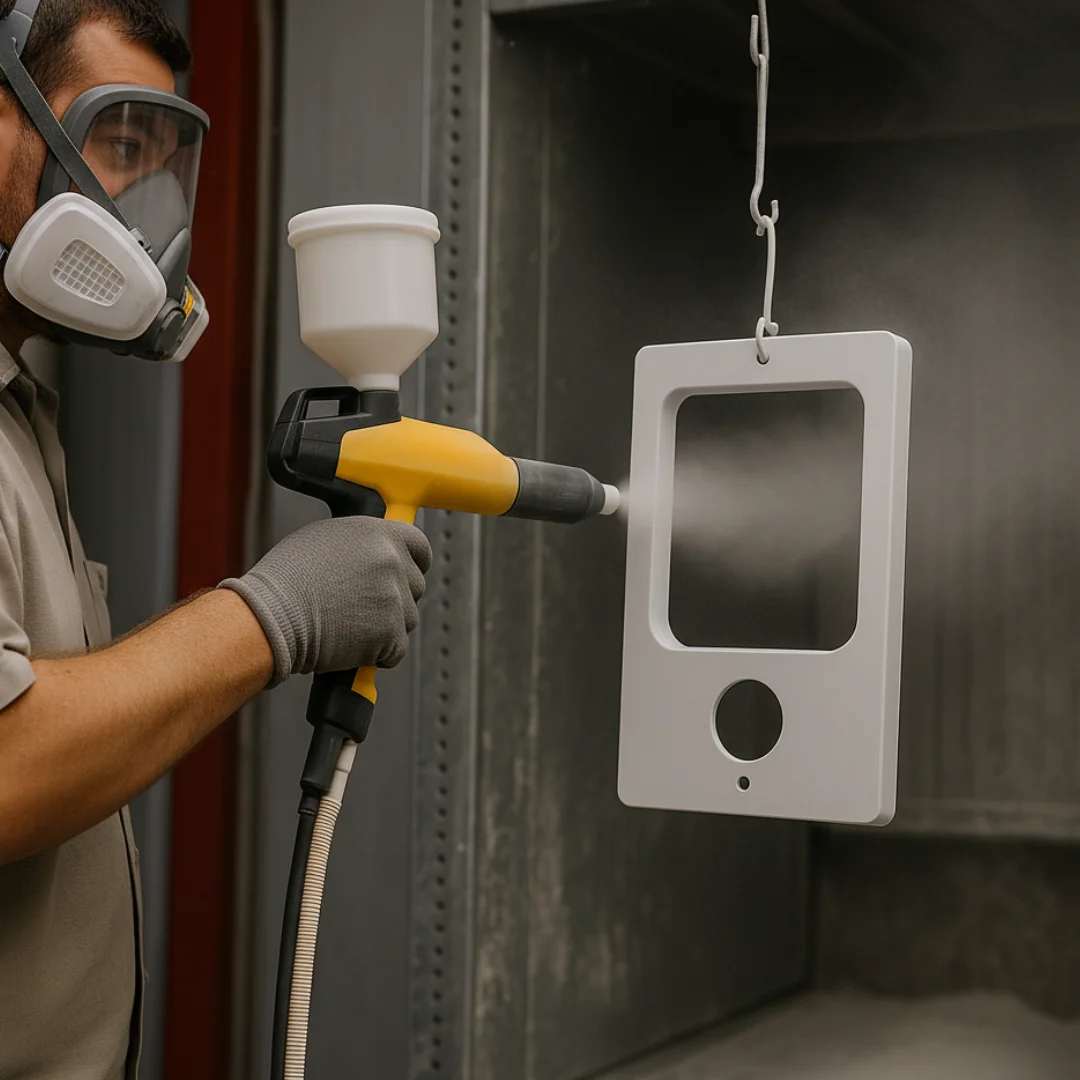
Powder coating applies a dry powder rather than a liquid paint. The powder is a mixture of pigments, resins, and additives that is applied electrostatically to the metal surface, then cured in an oven to form a hard, continuous film. The basic process follows four stages. First, the part is cleaned and pre-treated to prepare the surface for adhesion. Second, the powder is applied using an electrostatic spray gun, which imparts a charge to the powder particles that causes them to be attracted to the grounded metal part, producing even coverage including on edges and recesses. Third, the coated part is baked in a curing oven, typically at 180 to 200 degrees Celsius, where the powder melts, flows, and cross-links chemically into a solid film. Fourth, the part cools to room temperature and is inspected before dispatch. The result is a coating that is generally thicker and more impact-resistant than liquid paint, with no drips, runs, or solvent emissions during application.
Surface Preparation
Surface preparation is the most critical variable in powder coating quality. Even a technically correct application will fail prematurely on a poorly prepared surface. Contamination, mill scale, rust, or residual oil from machining or handling all prevent the powder from bonding correctly. Standard preparation for steel and cast components involves degreasing to remove oils and machining residues, followed by mechanical cleaning such as shot blasting or bead blasting to produce a consistent surface profile and remove scale or rust. For components that will be used in corrosive environments, a chemical pre-treatment such as zinc phosphating is applied after blasting. This converts the steel surface into a phosphate layer that both promotes adhesion and provides a secondary barrier against corrosion beneath the coating. The quality of surface preparation directly determines how well the coating performs in service. A coating applied over a shot-blasted and phosphated surface will significantly outlast the same coating applied over a lightly cleaned surface.
Indoor vs Outdoor Applications
The environment the coated part will be used in determines which powder chemistry is appropriate.
Indoor Applications
Parts used indoors, such as enclosures, frames, brackets, or machinery housings, are not exposed to UV radiation or weathering. For these applications, epoxy-based powders are a practical and cost-effective choice. Epoxy powders have excellent adhesion, good chemical resistance, and high hardness, making them suitable for components that may be exposed to cleaning chemicals or light mechanical wear. The limitation of epoxy powders is that they degrade under UV exposure, chalking and losing gloss over time when used outdoors. For indoor applications this is not relevant, which is why epoxy powders dominate interior industrial and commercial applications.
Outdoor Applications
Parts exposed to weather, sunlight, moisture, or temperature cycling require a powder that resists UV degradation. Polyester powders, including polyurethane polyesters, are the standard choice for outdoor applications. They maintain colour, gloss, and film integrity significantly better than epoxy powders when exposed to sunlight and weather cycling. For architectural hardware, handrail fittings, construction components, and any part installed in a coastal or industrial atmosphere, polyester powders are the correct specification. The actual service life depends on the quality of surface preparation, film thickness, the specific powder formulation, and the harshness of the environment. In sheltered outdoor environments with good preparation, a quality polyester coating can maintain its appearance for many years. In aggressive coastal environments with salt spray and intense UV, the same coating will degrade faster. Hybrid powder formulations that combine epoxy and polyester chemistry are also available, offering a balance of indoor toughness and moderate outdoor performance where neither pure formulation is ideal.
Powder Types and Their Properties
| Powder Type | Best For | UV Resistance | Chemical Resistance | Typical Application |
|---|---|---|---|---|
| Epoxy | Indoor use | Poor | Excellent | Machinery, enclosures, indoor hardware |
| Polyester | Outdoor use | Excellent | Good | Architectural hardware, handrails, construction fittings |
| Epoxy-polyester hybrid | Sheltered outdoor or indoor with some UV exposure | Moderate | Good | General industrial components |
| Polyurethane | Outdoor and high-wear applications | Very good | Very good | Automotive, outdoor furniture, high-end architectural |
What Affects Long-Term Durability
Several factors influence how long a powder coating holds up in service. Surface preparation is the most significant factor, as covered above. A poorly prepared surface allows moisture and corrosion to undercut the coating from beneath, causing peeling and failure regardless of how good the powder is. Film thickness affects impact resistance and barrier performance. Typical film thickness for powder coating is 60 to 100 micrometres. Too thin and the coating is vulnerable to through-film damage from impact or abrasion. Too thick and adhesion can be compromised on complex shapes. Powder selection must match the environment. Using an epoxy powder outdoors is a common cause of premature coating failure. The powder type must be specified based on the actual service conditions, not just the lowest cost option. Curing quality matters because under-cured powder does not fully cross-link, producing a film that is softer, less chemical-resistant, and more brittle than a fully cured coating. Oven temperature and dwell time must be controlled correctly for each part geometry.
Quality Control
Standard quality checks for powder-coated components include visual inspection for surface defects such as pinholes, orange peel, sags, or colour inconsistency. Film thickness is measured using a magnetic gauge at multiple points across the part to confirm it is within specification. Adhesion is tested using a cross-hatch test, in which a grid is scribed through the coating and adhesive tape is used to assess whether the coating lifts from the substrate. For components going into corrosive environments, salt spray testing to ISO 9227 can be specified to verify that the coating system meets a required corrosion resistance threshold before production begins.