Metal Injection Moulding:
How It Works and When to Use It
Metal Injection Moulding, commonly referred to as MIM, is a near-net-shape manufacturing process for producing small, complex metal components in high volumes. It sits at the intersection of two well-established technologies: the injection moulding process used for plastics, and the powder metallurgy techniques used to produce dense, high-performance sintered metal parts. The result is a process that can produce intricate geometries, tight tolerances and strong mechanical properties in a single production cycle, at unit costs that become very competitive at scale. What makes MIM commercially significant is the combination of capabilities it brings together in a single process. A component that would otherwise require multiple machining operations, assembly of separate parts, or compromise on geometry due to tooling constraints can often be produced as a single MIM shot, to tight tolerances, in a material with mechanical properties that compete with forging. For manufacturers working with small, high-precision components at volume, that combination changes the economics of production substantially.
How MIM Works
MIM follows four main stages from raw material to finished component.
Feedstock Preparation
The process begins by combining fine metal powder with an organic binder. The metal powder, typically stainless steel, iron-based alloys, titanium or tungsten alloys, is ground to a particle size below 20 micrometres. This is mixed with binders such as paraffin and thermoplastic polymers in a ratio of approximately 60% metal to 40% binder by volume. The mixture is heated and compounded until it behaves like a plastic, forming a granular feedstock that can be fed into standard injection moulding equipment.
Injection Moulding
The feedstock is heated until fluid and injected into a precision mould cavity under high pressure, in the same way plastic components are produced. Once cooled, the result is a green part: a component that holds its final shape but still contains all the binder material. Mould precision at this stage directly determines the starting dimensional accuracy of the part, so tooling quality is critical.
Debinding
The binder, which accounts for roughly 40% of the green part by volume, must be removed entirely before sintering. This is done through one of three methods: solvent extraction, thermal decomposition, or catalytic debinding. The output is a brown part, porous and structurally fragile, which retains the geometry of the green part but has had its binder removed. Brown parts require careful handling before sintering.
Sintering
The brown part is loaded into a furnace operating under vacuum or a controlled protective atmosphere and heated to approximately 85% of the metal’s melting point. At this temperature, the metal particles diffuse and fuse together, eliminating the internal porosity left by the binder removal. The component shrinks uniformly by 15 to 20% during this stage, which is a predictable and designed-in characteristic of the process. The finished part reaches a density of 96 to 99.5% of the theoretical maximum for the alloy, with mechanical properties close to those of wrought or forged metal.
MIM vs Other Processes
Understanding where MIM sits relative to other processes helps with selecting the right route for a given component.
| Process | Geometric Complexity | Mechanical Performance | Mass Production Cost | Typical Part Weight |
|---|---|---|---|---|
| MIM | Very high | High (near forging) | Very low at volume | 0.1g to 200g |
| Investment Casting | High | High | Low to medium | 10g to 50kg+ |
| CNC Machining | Medium | High | Very high | Unlimited |
| Die Casting | Medium | Medium (porosity risk) | Medium | Larger parts |
| Conventional PM | Low | Low (low density) | Low | Small to medium |
What MIM Does Well
MIM’s strongest qualities become clear when you understand the constraints of conventional processes.
Complex geometry is the primary advantage. MIM can produce thin walls, deep internal channels, undercuts, threads, and hollow structures in a single production cycle, without secondary machining. Features that would require multiple setups on a CNC machine, or that would be impossible to die cast due to tooling ejection constraints, can often be produced in MIM as a single shot.
Dimensional tolerance is also a genuine strength. Typical MIM tolerances reach plus or minus 0.05 mm, which competes directly with precision machining for many applications and exceeds what investment casting routinely achieves without secondary operations.
Material performance is strong relative to competing near-net-shape processes. MIM parts approach the density and mechanical strength of forged components, which places them well above conventional powder metallurgy parts and significantly above die castings, where residual porosity is a known limitation.
Material utilisation is close to 100%. Unlike machining, where a large proportion of raw material ends up as swarf, MIM uses nearly all the metal that enters the process. For high-value alloys, this is an important cost consideration.
At production volume, unit cost drops significantly. MIM tooling has a higher upfront cost than some alternatives, but the per-part cost at volume makes it one of the most economical routes for complex small components.
Typical Applications
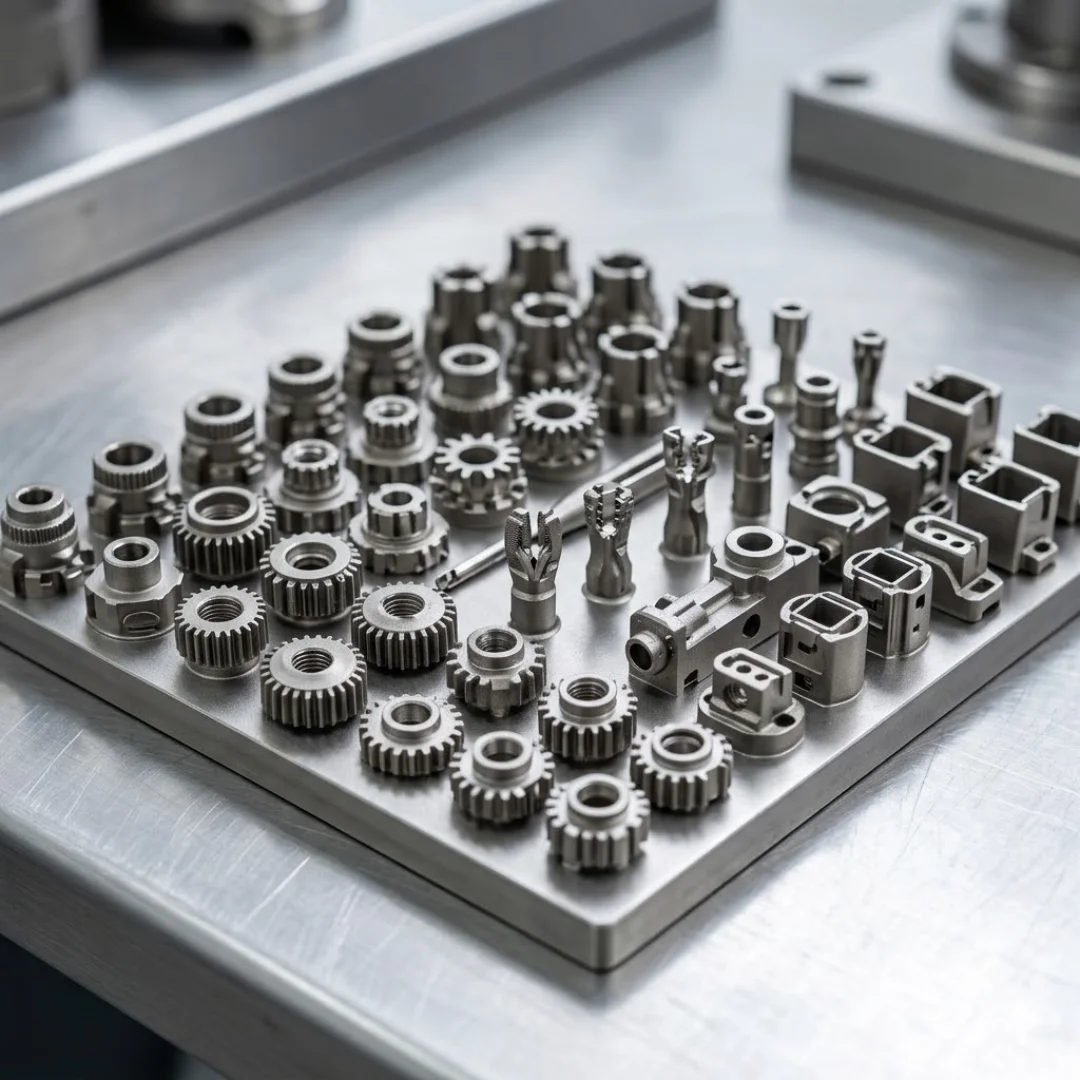
MIM is used across a wide range of industries where small, complex, high-precision metal parts are required in large quantities. In consumer electronics, MIM produces SIM card trays, camera module brackets and structural components for wearable devices. In the automotive sector it is used for turbocharger components, precision seat belt mechanisms and small engine parts. Medical and dental applications include surgical instrument components, orthodontic brackets and minimally invasive device parts. Hardware and tooling applications include lock mechanisms, watch components and gear assemblies for power tools. In aerospace and defence, MIM is used for small precision structural components and fuze parts. The common thread across these applications is small size (typically 0.1 to 200 grams), complex geometry, tight tolerances and production volume.
When MIM Is the Right Choice for Your Component
MIM is worth considering when your component combines several of the following characteristics: small size and low weight per part, complex three-dimensional geometry that would be expensive or impossible to machine, strict dimensional tolerances across multiple features, high production volumes where per-part cost matters, and alloy requirements that favour stainless steel, tool steel, titanium or other MIM-compatible materials. If you are unsure whether MIM or investment casting is the better fit for your component, the decision usually comes down to part weight, production volume and the complexity of internal features. We work with both processes and can assess your drawing to recommend the most cost-effective route.