
Investment Casting for Aerospace: Materials, Standards and Applications
Investment casting is one of the primary manufacturing processes used in aerospace. It produces complex, high-integrity metal components that cannot be made economically by any other method, from turbine blades operating at extreme temperatures to structural brackets carrying flight loads. This guide covers what makes investment casting suited to aerospace applications and what buyers and engineers need to know when specifying cast components.
Why Aerospace Uses Investment Casting
Aerospace components impose requirements that eliminate most manufacturing processes from consideration. Parts must be light, strong, dimensionally accurate, and reliable over long service lives in demanding environments. Investment casting meets these requirements because it can:
- Produce complex internal and external geometry in a single operation, eliminating joints and welds that are potential failure points
- Cast difficult high-performance alloys such as nickel superalloys, titanium, and cobalt chrome that are hard or impossible to machine from solid billet economically
- Achieve near-net-shape parts that minimise material removal and reduce the buy-to-fly ratio
- Deliver consistent, repeatable dimensions across production runs with full traceability
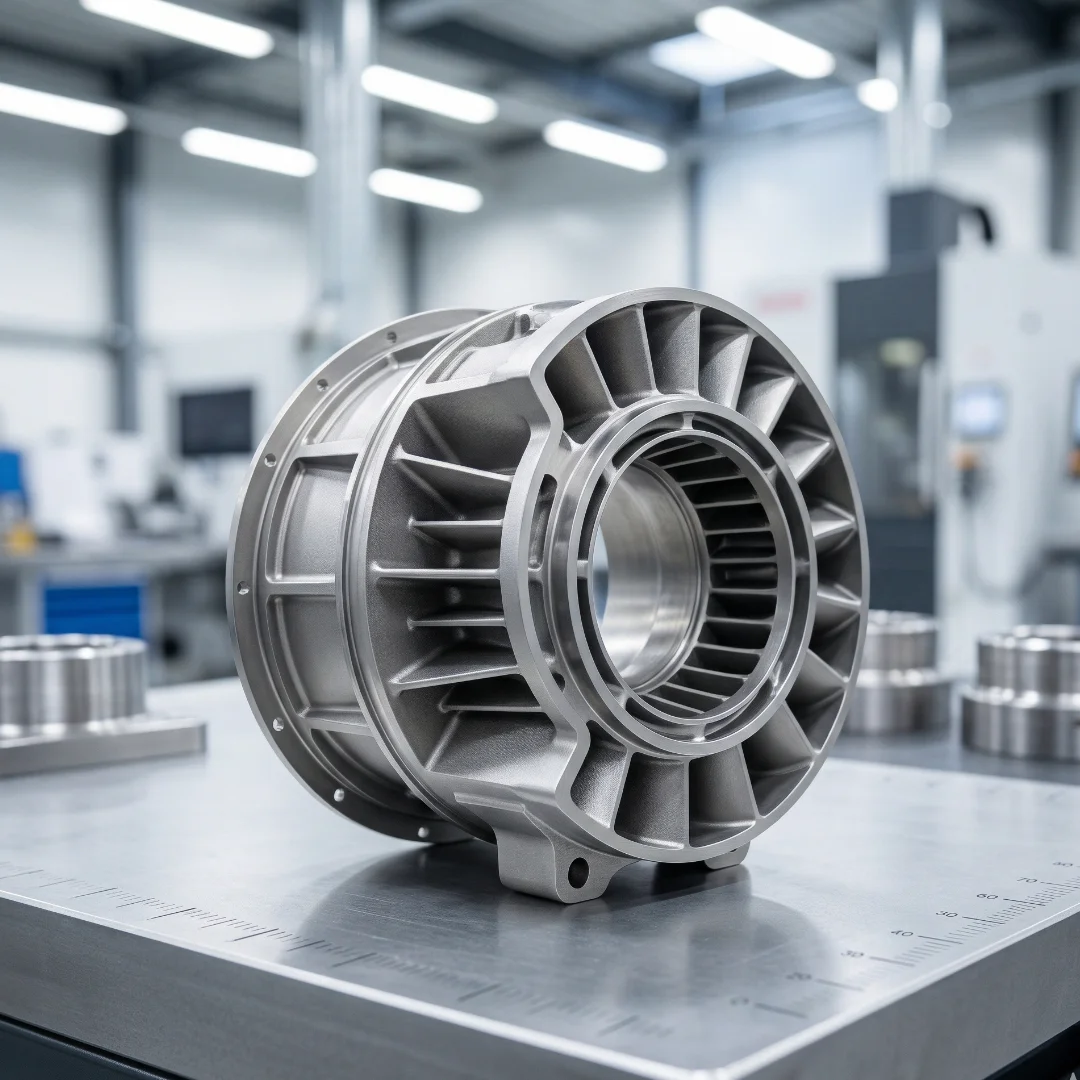
Aerospace Materials for Investment Casting
Nickel-Based Superalloys
Nickel superalloys are the defining material of aerospace investment casting. They retain mechanical strength at temperatures above 1,000°C, making them the only viable material for hot section turbine components. Common grades: Inconel 718, Inconel 625, Waspaloy, René 41. Applications: turbine blades, vanes, combustor components, nozzle guide vanes.
Titanium Alloys
Titanium offers an exceptional strength-to-weight ratio and good corrosion resistance. Investment casting of titanium requires vacuum or inert atmosphere to prevent contamination, but produces near-net-shape parts that are difficult to machine from billet due to titanium’s poor machinability. Common grades: Ti-6Al-4V (Grade 5), Ti-6Al-2Sn-4Zr-2Mo. Applications: structural brackets, frames, seat fittings, engine casings.
Stainless Steel
Stainless steel investment castings are used in aerospace for structural and secondary components where corrosion resistance and moderate strength are required. Common grades: 17-4 PH (high strength), 316L (corrosion resistance), 15-5 PH. Applications: actuator housings, fluid system components, brackets, fastener assemblies.
Aluminium Alloys
Aluminium investment castings offer low weight and good castability for non-structural aerospace components. Common grades: A356, A357. Applications: instrument housings, brackets, ducting components. Common grades: 17-4 PH (high strength), 316L (corrosion resistance), 15-5 PH. Applications: actuator housings, fluid system components, brackets, fastener assemblies.
Aerospace Casting Standards
Investment castings for aerospace applications are produced and inspected to recognised standards. Key standards include: AMS (Aerospace Material Specifications), published by SAE International, covering alloy composition, heat treatment, and mechanical property requirements for aerospace castings. AS9100 is the quality management system standard for aerospace manufacturers. Suppliers producing aerospace castings should hold AS9100 certification or be working toward it. ASTM E1742 and ASTM E1932 are radiographic and fluorescent penetrant inspection standards for aerospace castings. NADCAP (National Aerospace and Defense Contractors Accreditation Program) accreditation for casting and non-destructive testing is required by many aerospace primes. When sourcing aerospace castings, confirm which standards your supplier is certified to and ensure their quality system covers the specific processes required for your application.
Inspection and Non-Destructive Testing
Aerospace castings are inspected to confirm internal and surface integrity before release. Standard methods include: X-ray and CT scanning detects internal porosity, shrinkage, inclusions, and cracks without damaging the part. Fluorescent penetrant inspection (FPI) detects surface-breaking cracks and porosity on non-porous alloys. Dimensional inspection using a coordinate measuring machine (CMM) confirms that critical dimensions meet drawing requirements. Chemical analysis using spectrographic analysis confirms alloy composition. Mechanical testing covers tensile, hardness, and fatigue testing on witness samples from the same heat as production castings. The level of inspection required depends on the criticality of the component. Flight-critical structural parts typically require 100% X-ray inspection and a full CMM dimensional report. Non-structural secondary parts may require sampling inspection only.
Tolerances and Surface Finish
| Parameter | Standard Aerospace Casting | High Precision (post-machined) |
|---|---|---|
| Dimensional tolerance | ±0.1 to 0.25mm as-cast | ±0.01 to 0.05mm |
| Surface roughness | Ra 1.6 to 3.2μm as-cast | Ra 0.4 to 0.8μm |
| Minimum wall thickness | 1.5 to 2.5mm | n/a |
| Typical inspection | X-ray, FPI, CMM, chemical analysis | 100% X-ray or CT scan, full CMM report |
Design Considerations for Aerospace Investment Castings
Wall thickness: minimum wall thickness for most aerospace alloys is 1.5 to 2.5mm. Thinner walls are achievable but require careful gating design and process control. Radii and fillets: sharp internal corners create stress concentrations and hot spots during solidification. A minimum internal radius of 1.5mm is recommended. Larger radii improve casting soundness and fatigue performance. Machining allowances: allow 0.5 to 1.0mm machining stock on surfaces with tight tolerance or surface finish requirements. Datum features: identify clear datum surfaces on the drawing to allow consistent CMM inspection setup. Draft angles: investment casting requires minimal draft compared to sand or die casting, but zero-draft or negative-draft features should be discussed with your foundry early in the design process.
Applications by Aerospace Sector
Investment casting achieves ±0.1–0.25mm as-cast, tightened to ±0.01–0.05mm on machined surfaces. This means less material needs to be removed in secondary machining operations, which reduces cost and lead time on parts with tight tolerance requirements.
Commercial Aviation
Investment castings are used throughout commercial aircraft structures and systems, from engine hot section components to hydraulic manifolds, seat frame fittings, and interior hardware. The combination of complex geometry and light weight makes investment casting the preferred process for many structural brackets and housings. Investment casting tooling (the wax injection die) costs more, typically £1,500–£8,000 for most parts. However, the die lasts for very high volumes and the lower unit cost at medium volumes often recovers the tooling cost quickly.
Space and Launch Vehicles
Military aircraft impose more extreme performance requirements than commercial platforms. Investment casting is used for engine components, weapons system housings, structural elements, and landing gear components. Alloy selection and inspection requirements are typically more stringent than for commercial applications.
Defence and Military Aviation
Rocket engine components such as injectors, turbopump housings, and thrust chambers are among the most demanding applications for investment casting. These parts operate at extreme pressures and temperatures for short periods and require zero defects. CT scanning of every part is common.
